About Krishnagar Jagadhatri Puja
মহামায়া শ্রীশ্রীজগদ্ধাত্রী দেবীর ইতিহাস ও কৃষ্ণনগরের আধ্যাত্মিক ঐতিহ্য
Who is Maa Jagadhatri?
Jagaddhatri (or Jagadhatri) is the supreme aspect of the Hindu Divine Mother who upholds, nourishes, and sustains the universe. Her cult is deeply rooted in Shakta Tantra, where the Divine Mother is venerated in her three cosmic qualities (Gunas):
- 1. Sattva (Pure Illumination & Sustenance): Symbolized by Maa Jagadhatri.
- 2. Rajas (Dynamic Creation & Valour): Symbolized by Maa Durga.
- 3. Tamas (Dissolution & Transformation): Symbolized by Maa Kali.
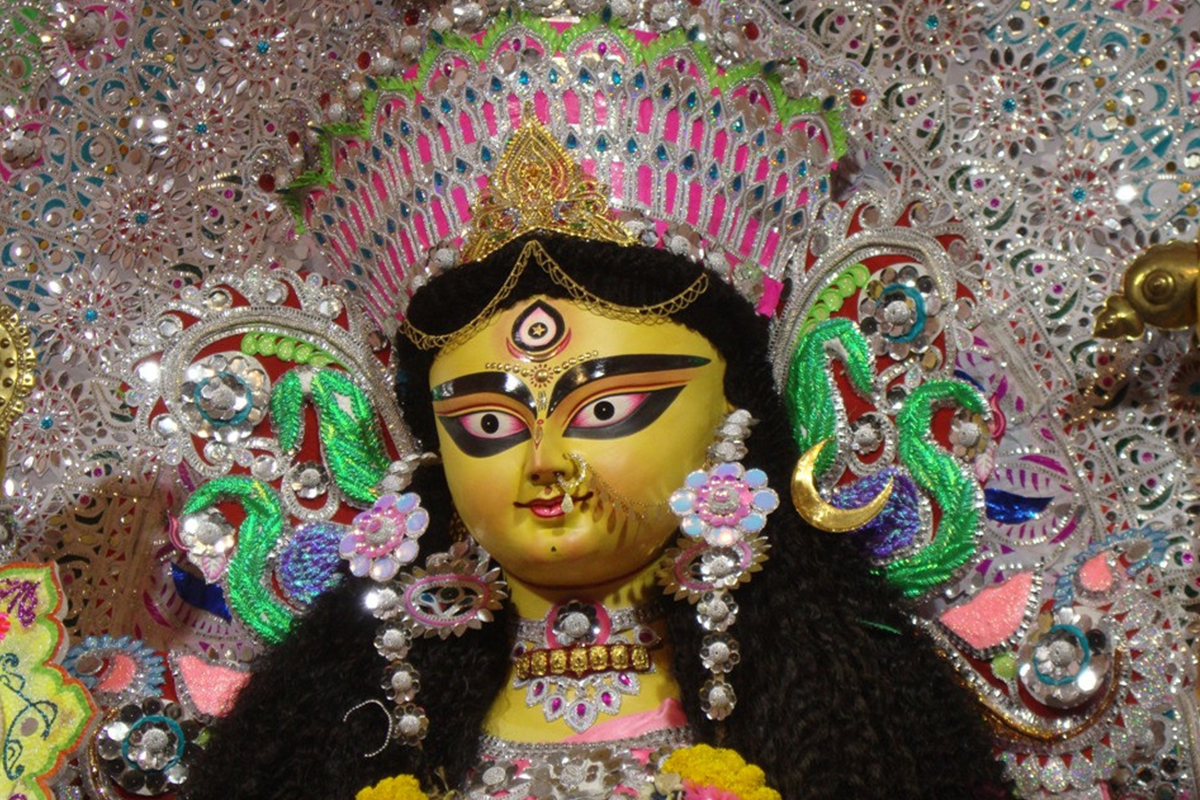
Maa Jagadhatri is depicted as possessing the radiant hue of the rising morning sun, three-eyed and four-armed, bearing the celestial Conch, Chakra, Bow, and Arrows. She wears a serpent as her sacred thread (nāgayajñopavīta)—a symbol of awakened Kundalini yoga and supreme Brahman. She rides majestically upon a lion standing over the vanquished elephant demon Karindrasura.
The Yaksha Vision & Conquest of Ego
1. The Fall of Celestial Pride
As recounted in the ancient Kena Upanishad and Puranic scriptures, soon after the vanquishing of Mahishasura, the Devatas became conceited. They believed that because of lending their weapons to Durga, the mighty asuras were conquered. To dispel their spiritual blindness, the Supreme Parabrahman manifested before them in the form of an effulgent, mysterious Yaksha.
Bewildered, the gods approached. First stepped forward Vayu, god of wind. The Yaksha placed a tiny blade of grass and bade him move it. Vayu exerted cosmic gale force, yet could not displace even a single speck!
2. The Revelation of Jagadhatri
Next approached Agni, god of fire. Agni summoned blazing infernos, yet could not singe the fragile blade of grass. One by one, every celestial divinity failed. Then the luminous Yaksha dissolved, and in that transcendent void appeared Maa Uma Haimavati (Jagadhatri).
She revealed that all cosmic power, intelligence, and life-force emanate solely from the Supreme Primordial Mother who sustains the universe. Anyone who meditates upon Jagadhatri becomes utterly egoless and a true instrument of divine grace.
"Jagaddhatri arises in the heart of a person who can conquer and subdue the frantic rogue elephant called mind."
— Sri Ramakrishna Paramahamsa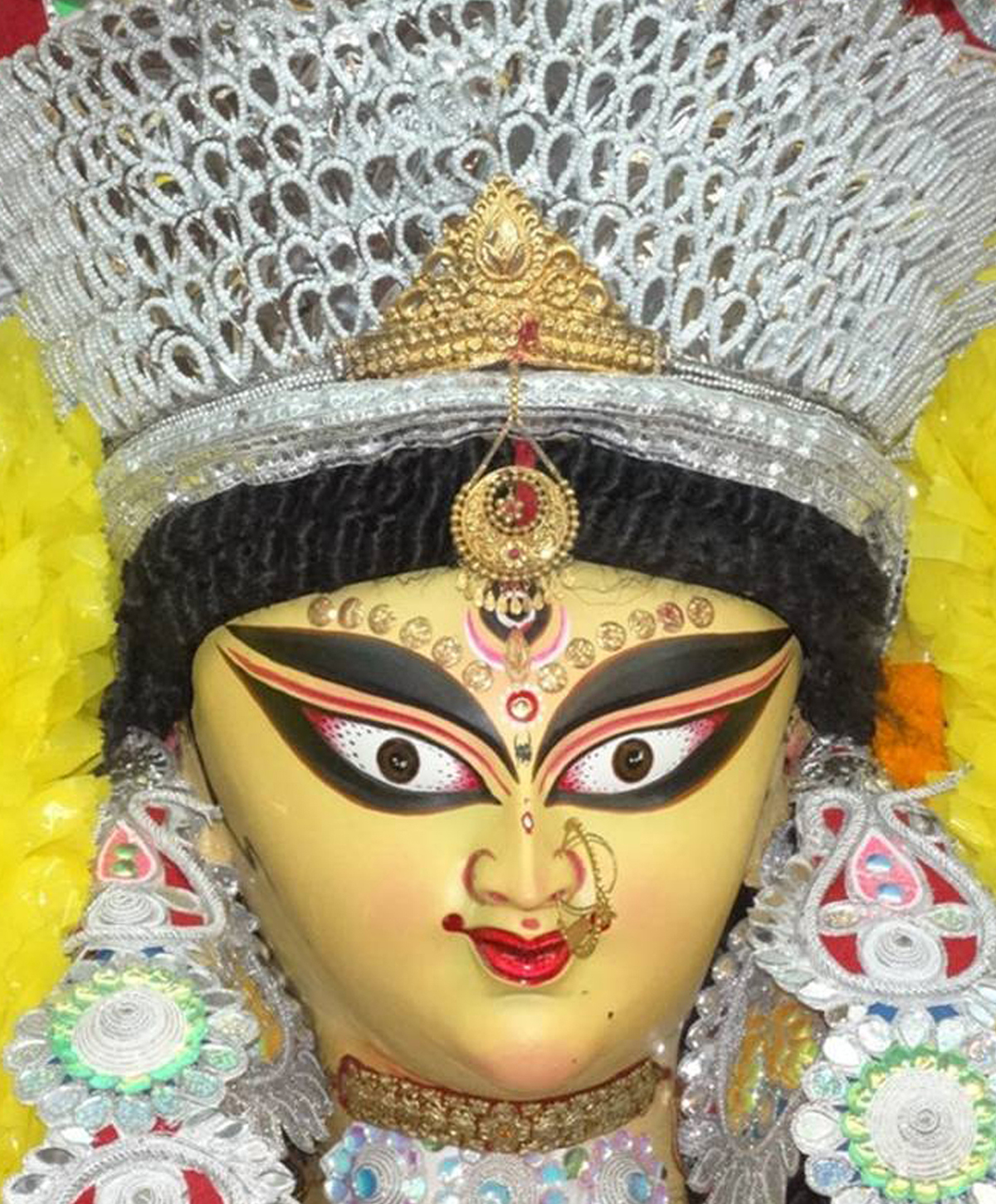
Anandamath & Mother India
Devi Jagadhatri occupies an immortal place in India's national awakening through the seminal novel Anandamath, written by Rishi Bankim Chandra Chattopadhyay, from which the national song "Vande Mataram" is drawn.
In the sacred sanctuary of Anandamath, the ascetics revere the motherland through the triumvirate of Goddesses:
- Jagadhatri: "The Mother as She once was" — Golden, sovereign, prosperous, and self-sufficient.
- Kali: "The Mother as She has become" — Beset by distress, dark times, and ascetic renunciation.
- Durga: "The Mother as She shall be" — Ten-armed, effulgent, victorious, and universally triumphant.
The Four Pillars of Krishnagar's Jagadhatri Heritage
The multifaceted cultural fabric combining royalty, master clay sculptors, living gold ornamentation, and the grandest immersion carnival.
1. Royal Antiquity
Celebrated without break since 1762 CE at the Krishnanagar Rajbari palace grounds under ancient Tantric Brihannandikeshwar rites.
2. Ghurni Clay Sculpting
Generations of master clay artisans crafting hyper-realistic idols on the banks of River Jalangi, celebrated throughout the world.
3. Pure Gold Shringar
Maa Buri Maa at Chasapara Barowari adorned with over 30 kg of pure gold jewellery gifted by generations of grateful devotees.
4. Sangsar Procession
The world's 2nd largest carnival parade carried on human shoulders (Beharas) with torches and Dhak beats toward Kadamtala Ghat.
Chronological Milestones of Krishnagar Jagadhatri Heritage
A definitive archival timeline charting 264+ years of royal sanction, community democratization, Ghurni artistic mastery, and digital preservation.
The Royal Vision at Jalangi
Maharaja Krishnachandra Ray, detained in Murshidabad by the Nawab and released on Vijaya Dashami, receives a divine dream aboard his boat on River Jalangi. Devi Jagadhatri ordains Her worship on Kartik Shukla Navami at the Nadia Rajbari, inaugurating the royal festival.
Democratization & Maa Buri Maa
Inspired by royal piety, the weavers and citizens of Chasapara institute the premier community Barowari Puja under the divine name "Maa Buri Maa" (The Elder Mother), transforming a royal court rite into Bengal's most inclusive mass devotional festival.
Ghurni Clay Modeling School
Centuries of generational clay masters along the Jalangi River bank in Ghurni pioneer hyper-realistic clay modeling with exact human anatomical fidelity and radiant classical facial features, securing worldwide acclaim for Bengal's earthen sculpting arts.
Anandamath & Patriotic Immortality
Rishi Bankim Chandra Chattopadhyay portrays Maa Jagadhatri as "Ma Ja Chhilen"—the embodiment of India's glorious, self-sufficient golden past in his seminal nationalist work Anandamath, infusing spiritual worship with national awakening.
Sangsar Shovajatra & Beharas
The Dashami immersion parade crystallizes into the world-renowned "Sangsar". Heavy multi-ton idols are carried shoulder-high across town by traditional bearer squads (Beharas) without touching the soil, culminating at Kadamtala Ghat amidst torchlight and Dhak rhythms.
Digital Heritage Preservation
Architected by City Light InfoTech Technologies as an ISO 9001:2015 cultural initiative, KrishnagarJagadhatriPuja.com establishes live streaming, digitized Sanskrit stotras, barowari registries, and interactive guides for millions of international devotees.
| Historical Era | Cultural & Spiritual Milestone | Archival Significance & Impact |
|---|---|---|
| 1762 CE Kartik Shukla Navami |
Royal Inception at Nadia Rajbari | Established by Maharaja Krishnachandra Ray under Brihannandikeshwar Tantric rites; set the benchmark for four-prahar ritual worship on a single auspicious day. |
| 1772 CE 18th Century Late |
Chasapara Buri Maa Barowari | First public community puja outside the palace walls; established the tradition of gold shringar and collective community participation (Barowari). |
| 18th–19th Cent. Colonial Era |
Ghurni Clay Modeling Eminence | Royal patronage fostered the Jalangi riverbank clay sculpting tradition, winning international medals at colonial exhibitions in London and Paris. |
| 1882 CE National Awakening |
Anandamath Representation | Rishi Bankim Chandra Chattopadhyay sanctified Maa Jagadhatri as the archetype of pristine Bharat Mata ("Ma Ja Chhilen"), inspiring freedom fighters. |
| 20th Century Post-Independence |
Sangsar Immersion Carnival | Establishment of the world's 2nd largest carnival procession featuring shoulder-borne palanquins (Beharas), torchlights (Moshals), and traditional Dhak contests. |
| Modern Day 2024–2026 CE |
Digital Global Portal | Official digital preservation portal powered by City Light InfoTech Technologies (ISO 9001:2015), connecting global diaspora and promoting Nadia tourism. |
Theological Iconography & Spiritual Symbolism
Deciphering the esoteric spiritual emblems of Devi Jagadhatri as revealed in the Brihannandikeshwar Purana and Mayadipika Tantra.
Architected & Powered by City Light InfoTech Technologies
The comprehensive digitization of Krishnagar Jagadhatri Puja's 260-year-old living heritage is an initiative engineered and maintained with reverence by City Light InfoTech Technologies. As an ISO 9001:2015 certified custom software and web development organization headquartered in West Bengal, City Light InfoTech Technologies delivers state-of-the-art high-performance digital infrastructure ensuring that Nadia's sacred art, historical barowaris, and divine rituals remain universally accessible to devotees and scholars across the globe.
City Light InfoTech Technologies
ISO 9001:2015 CertifiedEngineering Enterprise Web Applications, Android/iOS Mobile Apps, Billing Systems & High-Availability Portals with 24/7 dedicated support.